CelinQ Insights · No. 17
Reading an unfamiliar landscape quickly and honestly
Getting a trustworthy account of what a part of the model actually says.
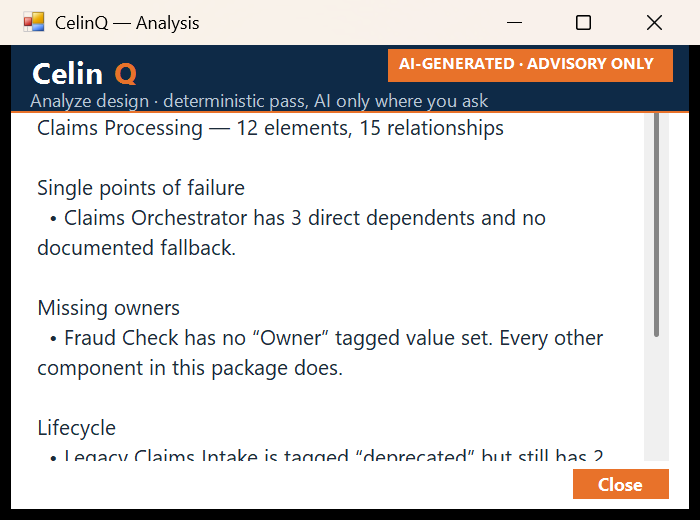
Every architect knows the feeling of being handed a part of a model they did not build and being expected to understand it by yesterday. A colleague has moved on, or a client hands over a repository built by a previous supplier, or you are asked to assess the impact of a change in a corner of the estate you have never opened. You double-click into the package and you are met with a wall of elements, a scatter of diagrams that may or may not be current, relationships whose direction you have to trace by eye, and naming that made perfect sense to whoever wrote it and means nothing to you. The information is all there. That is precisely the problem. It is all there, undifferentiated, and the work of turning it from data into understanding falls entirely on you.
What you actually want in that moment is not more diagrams. It is an orientation — a truthful, plain account of what this part of the model is saying, so that you know where to look closely and where you can safely skim. You want the equivalent of a knowledgeable colleague sitting next to you for ten minutes saying "this cluster here is the payments piece, these three talk to the external gateway, and this element over on the side is orphaned and probably left over from something". That kind of orientation is enormously valuable and it is almost never available, because the person who could give it has left, or is busy, or never wrote any of it down.
Why reading a model is so much harder than reading a document
It is worth understanding why comprehension is the expensive part, because the difficulty is structural rather than a failure of anyone's diligence. A document is linear; it tells you where to start and leads you through in an order the author chose. A model is a graph. It has no beginning. Meaning lives not in any single element but in the pattern of connections between them, and a human reading a graph has to hold a great deal in their head at once to see the pattern — which elements are central because everything depends on them, which are peripheral, which clusters are tightly bound and which connections cross between clusters and therefore mark the real seams of the design. None of that is visible from any one screen. You assemble it slowly, by clicking around, opening diagrams, following relationships, and building a mental map that the model does not hand you and mostly cannot.
This is slow even for the person who built the model, and it is punishing for someone who did not. Naming conventions that are obvious to the author are opaque to a newcomer. Diagrams drawn to make one argument are silent about everything else in the package. Relationships that are structurally load-bearing look exactly like relationships that are incidental, because the tool draws them the same way. And the model, having no narrative, offers no guidance about what matters. The reader has to supply all the interpretation, and interpretation of an unfamiliar graph is exactly the kind of work that is both cognitively heavy and easy to get subtly wrong.
A document tells you where to start. A model does not. The whole cost of understanding an unfamiliar landscape is the cost of building, by hand and in your head, the orientation the model itself refuses to provide.
A plain-language reading of what is actually there
The design assistant in CelinQ works in two directions. The forward direction, generating model content from a description, is covered elsewhere in this series. The reverse direction is the one that matters when you are facing an unfamiliar landscape: you point it at an existing part of the model, and it gives you back a plain-language reading of what that part actually contains — the elements, how they relate, what depends on what, where the clusters and the seams are. It is the knowledgeable-colleague orientation, produced on demand from the model in front of you, for a part of the estate where no such colleague exists.
The single most important word in that description is actually. The reading is derived from the real model content — the elements and relationships that are genuinely present in the package you selected — and not from anyone's recollection of what the model was supposed to contain, nor from documentation that may have drifted out of date years ago. This distinction is the whole value. The gap between what a model was intended to say and what it actually says is exactly the gap that catches people out, and it is precisely the gap a reading drawn from live content can close. When the documentation claims a component is decommissioned but the model still shows six things depending on it, a reading taken from the model will reflect the six dependencies, because it is reading the model and not the documentation. The truth you need is the one embedded in the structure, and that is the one the reading reports.
The honesty problem, taken seriously
An orientation is only worth having if you can trust it, and here the requirement is stricter than it is for the generation direction. When the assistant builds a design, you can see the result and check it against your intent; the output is inspectable model content. When it reads a landscape and tells you what is there, you are, by definition, asking about something you do not already understand — which means you are in the worst possible position to catch a confident-sounding account that is subtly wrong. A reading that quietly overstated its certainty, that smoothed over the parts of the model that are genuinely ambiguous, or that presented an inference as a fact, would be more dangerous than no reading at all, because it would give you false confidence about a landscape you cannot yet check for yourself.
This is why the honesty of the reading is not a nice-to-have but the entire point, and it is worth being concrete about what honesty means here. It means the reading describes what the model contains and refrains from inventing intent the model does not express. A model records structure; it does not, on its own, record why the structure is the way it is. An honest reading tells you that these elements are connected in this way and that this cluster depends on that component, because those things are in the model. It does not tell you that the design is good, or that the previous architect intended a particular strategy, or that a dependency is safe to remove — because none of that is in the model, and a reading that claimed it would be manufacturing meaning rather than reporting it. The reading is an account of the structure, delivered in language you can read quickly, and its trustworthiness rests on it staying inside the boundary of what the structure supports.
The reading answers "what does this part of the model actually say?" — not "was it a good idea?" and not "what did the author mean?". Keeping to that boundary is what makes it safe to rely on for a landscape you cannot yet check yourself.
Orientation, not a verdict
The right way to use the reading is as a starting point that tells you where to spend your own attention, not as a conclusion that saves you from having to look. This is a genuine distinction and it is the one that separates a useful tool from a hazardous one. The reading is the ten minutes with a knowledgeable colleague, and everyone understands that the colleague's overview is where you begin your investigation, not where you end it. It points you at the payments cluster, tells you which elements are central, flags the thing on the side that looks orphaned — and then you go and look at those things properly, with your own judgement, having been pointed in the right direction instead of starting from a wall of undifferentiated elements.
Framed that way, the reading does something quite specific and quite valuable: it collapses the first and dullest phase of understanding an unfamiliar model, the phase where you are just working out the shape of the thing and where the important parts are. That phase can eat a day or more on a substantial package, and almost none of it is skilled work; it is orientation labour, the model-reading equivalent of finding your way around a building. Compressing it means you reach the part that needs your actual expertise — assessing whether the design is sound, whether a change is safe, where the risks lie — sooner and with a clearer map. The expertise is still entirely yours to apply. What the reading removes is the tedious business of getting oriented well enough to apply it.
Where this matters most
There are a few situations where the reverse direction earns its place so clearly that it is worth naming them. The first is inheritance: taking over a repository built by someone who is no longer available to explain it. This is one of the most common and most under-served situations in the whole field, because the knowledge that would make the model legible walked out of the door with the person who had it. A reading drawn from the model itself is the only orientation that does not depend on that person, because it depends on the model instead. It cannot tell you what they were thinking, but it can tell you truthfully what they left behind, which is what you have to work with regardless.
The second is impact assessment. Someone asks whether a particular change is safe, and the honest answer depends on understanding what currently depends on the thing you are about to change. Tracing that by hand across an unfamiliar package is exactly the slow, error-prone graph-reading described earlier, and it is where mistakes get made — you miss a dependency because it was three relationships away and you did not follow that path. A reading that surfaces what depends on what, drawn from the live model, gives you a map of the neighbourhood before you start cutting, so your own careful assessment starts from a fuller picture rather than a partial one you assembled under time pressure.
The third is the periodic sanity check on your own model. Even architects who built a package themselves lose track of what has accumulated in it over months of edits by several people. Asking for a plain reading of a part of your own model is a way of seeing it fresh — of catching the orphaned element nobody remembered, the cluster that has grown denser than anyone intended, the dependency that crept in when two people extended the same area without coordinating. The reading holds a mirror up to the model as it actually is now, rather than as you remember leaving it, and the gap between those two is often where the surprises live.
The particular danger of a confident wrong reading
It is worth dwelling a little longer on the failure mode, because it is the thing that separates a tool an experienced architect will actually rely on from one they will try once and quietly abandon. The danger is not that a reading is occasionally incomplete; every orientation is incomplete, and everyone knows to treat an overview as an overview. The danger is a reading that is fluent, plausible, and wrong in a way you cannot detect, precisely because you are asking about something you do not yet understand. A halting, hedged account that admits its uncertainty is safe even when it is imperfect, because it invites you to check. A smooth account that asserts more than the model supports is dangerous exactly in proportion to how convincing it sounds, because it discourages the checking that would have caught it.
This is why the discipline of staying inside what the structure supports is not a limitation to apologise for but the feature that makes the reading usable. A reading that tells you "these six elements depend on this component" is making a claim you can verify by looking, and one that is grounded in relationships that genuinely exist. A reading that told you "this component is safe to retire" would be making a claim the model cannot support, because safety-to-retire depends on facts that live outside the model entirely — operational reality, contractual commitments, things nobody wrote down. The reading that refuses to make the second kind of claim is not being unhelpfully cautious. It is being honest about the boundary between what it can know from the structure and what it cannot, and that honesty is what lets you lean on the parts it does report. A tool that blurred that boundary to seem more helpful would be trading away the only thing that makes it trustworthy.
Comprehension as a shared asset
There is a team dimension to this that is easy to overlook when you think of comprehension as a private act. When one architect spends a day understanding an unfamiliar package, that understanding usually stays in their head. The next person who has to work in the same area starts from the same wall of elements and pays the same cost again, because comprehension, unlike a diagram, does not get saved anywhere. A model accumulates content but it does not accumulate understanding of itself, and so the cost of orientation is paid over and over by everyone who ever has to touch an unfamiliar corner.
A reading drawn on demand from the live model changes the economics of that quietly. Because the orientation is produced from the model itself rather than from any one person's memory, it is available to whoever needs it, whenever they need it, and it stays faithful to the model as the model changes rather than going stale the way a written hand-over note would. The second architect into a package does not depend on the first having documented their understanding; they get their own orientation from the same source. This does not replace the deep, hard-won familiarity that comes from working in an area for months — nothing does — but it means the shallow, repeatable, first-pass orientation is no longer a private cost that every newcomer pays from scratch. The model becomes a little more able to explain itself, which is a property a graph does not naturally have and has to be given.
How it fits the rest of the platform
Because the reading is derived from real model content in your local repository, it participates naturally in everything else CelinQ does. The part of the model you are reading is the part that has been kept reconciled with the shared workspace by the background sync, which means the reading reflects the team's current shared understanding of that area, not a stale private copy. And because it works against your local repository, it works at full speed and without needing to be connected, so you can orient yourself in an unfamiliar package on a train or at a client site with no network, exactly when you are most likely to have been handed a repository you have never seen and asked what it means.
It is worth repeating the point about scope that runs through everything CelinQ does, because it applies here just as it does to the generation direction. The design assistant, in both directions, is optional and off by default. The core of the platform — the local-first repositories, the deterministic merge, the ordered history, the governance over changes — works entirely without it and needs no external service to do so. The reading capability is something you enable when it is useful to you, on a foundation that stands perfectly well on its own. Everything can remain under your organisation's control. The orientation the reading gives you is a convenience layered on top, not a dependency you are obliged to accept, and that separation is deliberate.
The discipline of a reading you can trust
If there is one thing to hold on to about reading an unfamiliar landscape this way, it is that the value and the danger come from the same place, and telling them apart is a matter of discipline. The value is that you get a fast, plain account of what a part of the model actually contains, drawn from the model rather than from anyone's fallible memory of it. The danger, in any tool of this kind, is the temptation to treat that account as more than it is — to let a fluent orientation stand in for the careful examination it was only ever meant to accelerate. The whole design of the reading is oriented toward staying honest about that boundary: describing structure, not inventing intent; giving you a map, not a verdict; pointing your attention rather than replacing it.
Used that way, it changes the economics of comprehension in the same way the generation direction changes the economics of transcription. The dull, heavy, unskilled first phase of understanding a model — finding your way around, working out the shape, locating the important parts — shrinks from a day to a short read, and the skilled part, the judgement that only you can bring, begins from a clearer starting point. You still do the hard thinking. You just no longer have to spend the morning getting oriented well enough to begin it. For anyone who has ever been handed a stranger's repository and asked what it means, that is not a small thing. It is the difference between starting the real work at nine and starting it at three.
The unfamiliar landscape does not become familiar because a tool described it to you; familiarity is still earned by looking closely, and the reading never pretends otherwise. What it offers is a truthful first sight of the terrain, taken from the terrain itself, so that when you go in to look closely you already know roughly where the valleys and the cliffs are. That is exactly what a knowledgeable colleague would give you in ten minutes, and it is exactly what is missing precisely when you need it most. Having it drawn honestly from the model, on demand, is a modest promise, and it is one worth keeping carefully rather than overselling.
Recognise this in your own team? Get in touch — we’re happy to talk through whether CelinQ fits, no pressure either way.